Private music lessons in the UK cost roughly £15–£32 for 30 minutes and £28–£65 for an hour in 2026. Piano is typically £18–£30 a half hour, guitar and drums £15–£28, singing £18–£32. London and the South East run 20–40% above those ranges, and the Musicians’ Union publishes a recommended hourly rate that sits near the top of them.
Ask what music lessons cost in the UK and you’ll get answers ranging from £12 to £90 an hour — all of them true somewhere. The honest answer is a range with reasons, and once you understand the reasons, both sides of the transaction make better decisions: parents know what they’re buying, and teachers stop pricing by rumour.
This guide covers what lessons typically cost in 2026, why the spread is so wide, and — if you’re the one setting prices — how to work out a rate from your own numbers rather than the teacher down the road’s.
The short answer
For individual lessons with a qualified private teacher in 2026, most of the UK sits in these bands:
| Lesson | Typical range (30 min) | Typical range (60 min) |
|---|---|---|
| Piano | £18–£30 | £35–£60 |
| Guitar | £15–£28 | £30–£55 |
| Singing / voice | £18–£32 | £35–£65 |
| Violin & strings | £17–£30 | £34–£60 |
| Drums | £15–£28 | £30–£55 |
| Woodwind & brass | £16–£30 | £32–£58 |
| Music theory | £15–£25 | £28–£50 |
Three caveats worth taking seriously:
- London and the South East run 20–40% above these ranges. A £40 half-hour in Zone 2 is unremarkable; the same lesson in Carlisle would raise eyebrows.
- The Musicians’ Union publishes recommended hourly teaching rates (updated annually — check the current figure on the MU’s website). The MU rate is a floor for professional, qualified teaching, and sits towards the top of the ranges above. Many excellent teachers charge below it; very experienced and specialist teachers charge well above.
- These are private-teacher rates. Group lessons, whole-class school programmes and online-only marketplaces all price differently — more on those below.
Why the spread is so wide
Five factors explain almost all of the variation, and they’re worth understanding whichever side of the invoice you’re on.
1. Region
The same lesson is priced against local incomes and local costs. London, the South East, Edinburgh and the affluent commuter belts price highest; rural areas and lower-income towns price lowest. The teacher’s costs move too — a teaching room in central London can cost more per hour than the entire lesson fee elsewhere.
2. Experience and qualifications
A conservatoire graduate with twenty years of teaching, a diploma and a track record of distinction-grade pupils is selling a different product from a gigging musician who teaches on the side — even if both are good. Qualifications that legitimately move rates: music degrees and conservatoire training, teaching diplomas (ABRSM, Trinity, LCM), examiner experience, and a verifiable record of exam and audition results.
3. Instrument and specialism
Singing and piano typically price at the top of the range — partly demand, partly because the supply of highly qualified teachers is thinner than for guitar. Specialisms push higher still: jazz piano, audition coaching for conservatoire entry, or advanced-grade exam preparation are all priced above the general rate.
4. Lesson length — and the 30-minute illusion
Note from the table that half-hour lessons are more than half the hourly price. That’s not sharp practice. A 30-minute lesson carries the same fixed costs as an hour — the same gap in the diary either side, the same notes written afterwards, the same parent messages — so per-minute pricing is genuinely more expensive to deliver. Teachers: if your 30-minute rate is exactly half your 60-minute rate, your shortest lessons are quietly your worst-paid work.
5. The setting
- A pupil travelling to the teacher is the baseline price.
- The teacher travelling to the pupil adds £5–£15+ per lesson, because travel time is unpaid teaching time. In London, home-visit lessons routinely exceed £60/hour all-in.
- Online lessons typically price the same as in-person or slightly below — the teacher’s time is identical, even if the room is cheaper.
- Group lessons cost each family less (commonly £8–£15 per pupil per session) while paying the teacher more per hour. Good group teaching is its own skill, but the economics are excellent for both sides.
What about “cheap” lessons?
You’ll find lessons advertised at £10–£15 an hour on marketplace sites. Sometimes that’s a genuinely good student teacher building experience — a perfectly reasonable choice for a beginner trying an instrument out. But a price that low usually means one of: no qualifications, no DBS check, no insurance, no policy when things go wrong, or a teacher who hasn’t yet done the maths on their own business and will burn out or quit mid-term. The cheapest lesson that ends in March costs more than the fairly-priced one that runs for years.
Parents comparing teachers should weigh, alongside price: an Enhanced DBS check, public liability insurance, qualifications, a written cancellation policy (its existence is a quality signal — it means you’re dealing with a professional), and how progress is communicated between lessons.
For teachers: how to set your rate properly
Here’s the part most pricing guides skip. The local going rate tells you what the market tolerates — it tells you nothing about whether that rate funds your life. Working backwards from your income goal does.
The arithmetic is simple:
(Target income + business costs) ÷ realistic paid hours = your hourly rate.
The three traps are all in the inputs:
- Business costs are real. Insurance, room hire, sheet music, instrument upkeep, exam entries, software, CPD — for many teachers £1,500–£3,000 a year. If your rate doesn’t carry them, your “income” is partly an illusion.
- Teaching weeks aren’t 52. UK term-time teaching is typically 36–39 weeks. A rate computed on 52 weeks understates what you need by a third. (Count your actual year with our term date planner.)
- Slots don’t fill perfectly. Gaps between pupils, churn, the 4pm slot nobody wants — realistic utilisation is 85–90%, and your rate has to absorb the rest.
We built a free calculator that does exactly this sum — income, costs, weeks, hours, unfilled slots in; required hourly rate out, with per-30-minute and per-45-minute prices: the hourly rate calculator. No email required; the maths runs on the page.
Two more pricing principles that pay for themselves:
Raise prices annually, slightly, predictably. A £1–£2 rise each September with a term’s notice is absorbed without comment. Holding your rate for five years and then jumping £8 loses pupils — not because of the number, but because of the shock. Your costs rise every year; your rate should too.
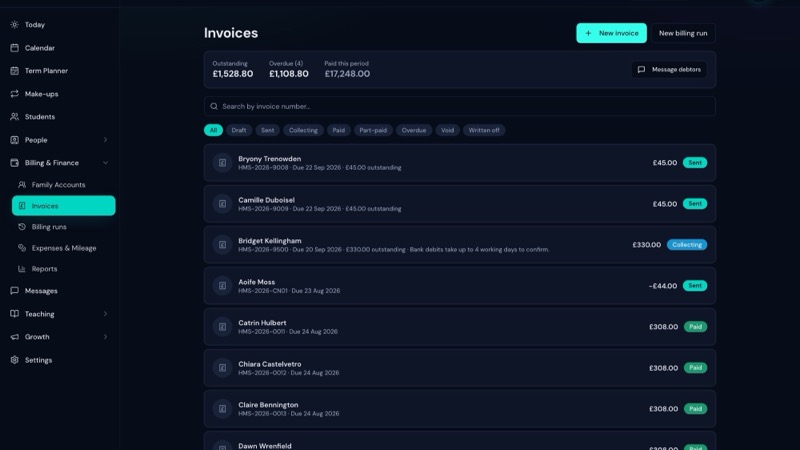
Charge by the term, not the lesson. Termly billing — the UK norm for established schools — smooths your cash flow, slashes your admin, and reframes the purchase from “another £25 this week” to “this term’s music education”. It also pairs naturally with a clear cancellation and make-up policy, which is the document that makes termly billing feel fair.
For parents: what a fair deal looks like
A fair price is the one that keeps a good teacher teaching your child for years. The full cost of music education is roughly: lessons (36–39 weeks × the rate) + an instrument (rent first — £15–£40/month for most instruments — buy when commitment is proven) + books and exam fees (ABRSM and Trinity grade exams run from roughly £50 at the early grades to over £100 at the top) + the practice time that makes all of it worth anything.
If the budget is tight, the order to economise: shorter lessons before cheaper teachers, group lessons before no lessons, and a rented instrument before a skipped term. The teacher relationship is the asset; protect it first.
Quick answers
Why do teachers charge for missed lessons? Because the slot was reserved and the teacher engaged — the cost happened whether or not the pupil arrived. Good studios publish exactly how this works in a cancellation and make-up policy; its existence is a mark of professionalism, not meanness.
Are online lessons worth the same money? For most pupils past the first term, yes — the teacher’s expertise and attention are identical, and the format removes travel for both sides. Absolute beginners on physical-setup-heavy instruments (violin posture, drum kit setup) benefit most from in-person starts.
Is £20/hour too cheap to be good? Not necessarily — region and career stage matter. But ask the quality questions (DBS, insurance, qualifications, policy) with extra care, and note whether the teacher seems to be running a sustainable business. The relevant risk isn’t a bad lesson; it’s a good teacher who quits.
How much should lessons cost for an adult learner? The same as for children — the hour costs the teacher the same. Some teachers price daytime adult slots slightly lower because they fill hours children can’t use; that’s a scheduling discount, not an adult discount.
When is a price rise reasonable? Annually, modestly, with a term’s notice. UK teachers’ costs — rooms, insurance, music, exam fees — rise every year; a frozen rate is a shrinking one.
Written by Lauren, co-founder of LessonLoop and founder of LTP Music — 500+ pupils, 23 years at the piano, and every pricing mistake in this article made personally at least once. LessonLoop is music school software that bills your real rate, every term, automatically.