A UK state school year is 195 days — 190 teaching days plus five INSET days — packed into roughly 39 weeks. Private music teachers typically bill 36 to 38 teaching weeks. Scotland runs about 38. Almost every English bank holiday is a Monday, so a Monday pupil gets two to three fewer lessons a year than a Wednesday pupil.
Here’s a question that decides whether your termly fees are fair, your annual income forecast is real, and your September diary survives contact with reality: how many weeks will you actually teach this year?
Most people answer “about 39 — same as schools.” Almost nobody’s right. The gap between the official school year and a music teacher’s real teaching year is where underpriced terms, accidental bank-holiday lessons and January cash-flow dips all come from. Let’s count it properly.
The official answer: 195 days, 39 weeks
State schools in England and Wales are open for 195 days a year — 190 teaching days for pupils plus five INSET days — which packs into roughly 39 weeks of term. The familiar shape:
- Autumn term: early September to mid/late December (≈ 14–15 weeks, one half-term break)
- Spring term: early January to late March/early April, pinned to Easter (≈ 11–12 weeks, one half-term)
- Summer term: mid-April to mid/late July (≈ 12–13 weeks, one half-term)
Scotland runs a different pattern (mid-August start, October week, late-June finish — typically 38 weeks). Northern Ireland starts around 1 September and finishes around 30 June. And within England alone, over 150 local authorities set their own dates — Easter in particular swings term boundaries by up to two weeks between councils, and academies can diverge from their own council entirely.
The practical rule: never assume. Check the council (or school) calendar for every venue you teach in, every year. If you teach in three schools across two authorities, you can genuinely face three different half-term weeks.
The real answer: you teach less than 39 — and unevenly
The official year is the ceiling, not your number. Three subtractions follow:
1. Most private studios teach 36–38 weeks
Most term-time studios trim the schools’ 39: starting the week after schools return, stopping a few days before the Christmas concert chaos, skipping the INSET-pocked first week of summer. 36 to 38 teaching weeks is the realistic UK norm — and it’s the number that should sit in your fee maths and your income forecast. (If you charge an hourly-derived termly fee computed on 39 weeks but deliver 36, you’ve quietly discounted yourself 8%.)
2. Bank holidays eat term days — unevenly
Some bank holidays fall safely in school holidays (Christmas, New Year, Easter Monday in most years). But the May Day and late-May holidays land in term time nearly every year, and the late-May one only escapes if it coincides with half-term — which depends on your council’s dates.
3. Mondays lose the most. Every year.
Here’s the fact that should change how you bill: almost every English bank holiday is a Monday. Early May: Monday. Spring bank holiday: Monday. Easter Monday: Monday. Summer bank holiday: Monday (out of term, mercifully).
Run the count for a typical 2026/27 England & Wales year and the Monday pupil gets two to three fewer lessons than the Wednesday pupil — before a single child gets ill. If every weekday pupil pays the same flat termly fee, your Monday families are subsidising everyone else, and sooner or later one of them counts.
We built a free tool that does this count for your actual dates: enter your three terms and half-terms, pick your nation’s bank-holiday set, and it shows teaching weeks, total teaching days, lessons per weekday (the Monday deficit, made visible), which bank holidays land inside term — plus a calendar (.ics) file with all of it, and suggested billing dates. The term date planner — free, no email, runs on the page.
Turning the count into money: termly fees that add up
Once you know the real lesson counts, termly billing becomes arithmetic instead of estimation:
Termly fee = lessons actually occurring that term × your per-lesson rate.
This is the fairest model in the UK system, and it produces different fees for different weekdays and different terms — the autumn term bill is bigger than the spring one because it has more weeks. Parents accept this instantly when the invoice line says “11 × Monday lessons @ £22” rather than a mysterious flat number. The alternative — one flat termly fee — only stays fair if you compute it from the yearly total (count the year’s lessons per weekday, divide by three) and say so.
Two related rules earn their keep:
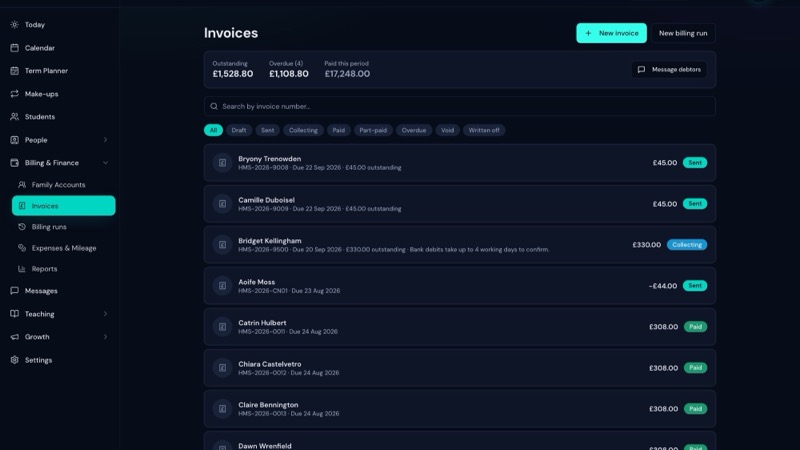
Invoice before the term, not during it. An invoice sent two weeks before term starts is paid from September optimism, not chased through November. Three billing dates a year, each a fortnight before a term begins — the term planner generates them for you. (And if invoicing 80 families three times a year sounds like an evening lost each time — that’s a billing run in LessonLoop, one click, every family, to the penny.)
Publish your closure dates with your fees. A September letter (or portal page) listing term dates, half terms and the bank holidays you’re closed kills the “but we had a lesson booked on May Day?” conversation before it exists. It’s also the natural place to restate your cancellation and make-up policy — dates and rules, decided once, in one document.
The cash-flow shape of the teaching year
Counting weeks also explains the income rhythm that surprises every new full-time teacher:
- The year pays you for ~37 weeks across 12 months of bills. A £25,000 teaching income is really £675 per teaching week, but your rent is monthly and indifferent to half-term — so the summer gap (late July to early September, six-plus weeks long) has to be pre-funded by the other three seasons.
- Spring term is short. Eleven weeks against autumn’s fourteen-plus. If you bill by lessons delivered, January’s invoice run is your smallest — plan around it rather than being ambushed.
- Holiday weeks aren’t dead weeks. Intensive courses, exam-prep bootcamps, theory workshops and holiday clubs all monetise school holidays at premium day rates, smoothing the curve. Even two summer workshop weeks materially change the August picture.
A sensible operating pattern: forecast the year on 36 teaching weeks (pessimistic by design), bill each term in advance, and treat anything you earn in week 37+ or in holidays as margin rather than baseline.
Your 2026/27 checklist
Before September:
- Collect the term-date calendars for every council/school you touch — this year’s, not last year’s.
- Set your studio’s dates — start, end and half-terms for all three terms. You don’t have to match the schools exactly; you do have to publish whatever you choose.
- Run the weekday count in the term planner and check the Monday/Friday deficits.
- Price each term from its real lesson count — or compute a justified flat fee from the yearly total.
- Diary the three billing dates, each ~two weeks before a term starts.
- Publish dates + policy together to every family, and put the .ics in your own calendar so closures can’t be double-booked.
One afternoon, once a year — and the diary, the fees and the cash flow all stop arguing with you by Christmas.
A worked example: pricing the 2026/27 year
To make the whole method concrete, here’s a typical England & Wales 2026/27 studio year — autumn term 1 September to 18 December (half term 26–30 October), spring 4 January to 25 March (half term 15–19 February), summer 12 April to 16 July (half term 31 May to 4 June) — for a teacher charging £22 per 30-minute lesson.
Count the weekdays inside term, outside half-terms, minus bank holidays, and you get roughly: Mondays 33 · Tuesdays 36 · Wednesdays 36 · Thursdays 36 · Fridays 35. (Early May and the spring bank holiday both land on term-time Mondays in this pattern; Good Friday trims a Friday.)
Priced honestly, the year for a weekly pupil is:
| Weekday | Lessons/year | Annual total | Per term (÷3, flat) |
|---|---|---|---|
| Monday | 33 | £726 | £242 |
| Wednesday | 36 | £792 | £264 |
Two readings of that table. Per-term-by-count: the Monday family’s autumn invoice lists its actual Monday count at £22 each — different each term, transparently fair. Flat-fee-by-year: both families pay the same three instalments only if you computed each weekday’s flat fee from its own annual count — £242 a term for Mondays, £264 for Wednesdays. What’s not defensible is charging both £264 because Wednesdays were the day you happened to count.
That £66-a-year gap per Monday pupil is the entire argument for counting. Across fifteen Monday pupils, it’s a four-figure sum someone is silently paying — either your families (overcharged) or you (undercharging the other days).
Written by Lauren, co-founder of LessonLoop and founder of LTP Music — a 500-pupil school timetabling across more than a dozen schools and two authorities every week. LessonLoop bakes terms, closures and billing runs into the product, so this article’s checklist happens automatically.