Self-employed music teachers register for Self Assessment once gross self-employed income passes the £1,000 trading allowance. The tax year runs 6 April to 5 April, and the online return and payment are due 31 January. Business mileage is 45p a mile for the first 10,000 miles and 25p after that. As a planning rule, set aside 25–30% of profit.
Nobody becomes a music teacher to learn tax law — which is exactly why so many teachers overpay. Not through HMRC fines (though January panic causes those too), but through the quieter route: unclaimed expenses, missing records, and income totted up from four different apps at year end with the gaps rounded against you.
This guide covers the system as it applies to self-employed music teachers in 2026/27: what to register for, what you can genuinely claim, what Making Tax Digital changes, and the small record-keeping habits that make the whole thing boring — which is the goal.
The obligatory honest line: this is general guidance, not personalised tax advice. Rates and thresholds change at Budgets; check gov.uk or an accountant for your specific numbers.
The basics: who files, and when
If you teach privately and aren’t taxed through an employer’s payroll for that work, you’re self-employed for it — even if you also have an employed job (peripatetic teachers commonly mix both). The essentials:
- The £1,000 trading allowance. If your gross self-employed income is under £1,000 in a tax year, you generally don’t need to register or file at all. Above it, you register for Self Assessment. (You can also choose to claim the £1,000 allowance instead of your actual expenses — worthwhile only if your real costs are under £1,000, which for a working music teacher they rarely are.)
- Key dates. The tax year runs 6 April to 5 April. Register by 5 October after the tax year you started; online returns and payment are due 31 January. If your bill tops £1,000, HMRC also wants payments on account — two advance instalments (31 January and 31 July) towards next year, which is the cash-flow ambush every newly-profitable teacher hits exactly once.
- What you pay. Income tax on profits (income minus allowable expenses, minus your Personal Allowance) plus Class 4 National Insurance on profits above the lower threshold. As a planning rule of thumb, set aside 25–30% of profit — refine it once you’ve seen a real year.
Allowable expenses: the list that pays for the article
The principle is “wholly and exclusively” for the business. For a music teacher, that covers more than most people claim:
Instruments and equipment. Instruments used for teaching, repairs, servicing, strings/reeds/sticks, music stands, amps, recording gear, a laptop or tablet used for the business. Larger purchases are typically claimed via capital allowances (in practice, the Annual Investment Allowance usually lets you deduct the full cost in-year — your accountant or software handles the mechanics).
Music and materials. Sheet music, books, backing tracks, manuscript paper, software subscriptions (notation software, backing-track apps — and yes, your studio-management software is deductible).
Where you teach. Rented teaching rooms in full. If you teach from home, either the flat-rate simplified expenses for home working, or a reasonable proportion of household costs (a methodical room-count/hours calculation — document your method and keep it consistent).
Travel. For teaching at pupils’ homes or multiple schools: 45p per mile for the first 10,000 business miles, 25p thereafter under HMRC’s approved mileage rates — or actual vehicle costs proportioned to business use (pick one method per vehicle and stick with it). Commuting to a single regular workplace doesn’t count; travelling between teaching venues generally does. A mileage log is the difference between claiming this and forfeiting it — date, from, to, miles, purpose.
Professional costs. Public liability insurance, instrument insurance, MU or ISM membership, DBS-related costs where required for your self-employed work, accountancy fees, CPD directly related to your teaching (courses, consort workshops, exam-board training).
Running the business. Phone and internet (business proportion), website and booking software, advertising, exam-entry fees you pay on pupils’ behalf (with the reimbursements counted as income), bank charges on a business account.
What you can’t claim: everyday clothing (even concert blacks, by long-standing case law), the non-business share of anything, HMRC penalties, and “networking” that is, on inspection, dinner.
The meta-rule: every unclaimed £100 of expenses costs a basic-rate taxpayer roughly £26 in unnecessary tax and NI (20% income tax plus 6% Class 4 NI). The list above routinely adds up to £1,500–£3,000 for a working teacher. The reason teachers don’t claim it isn’t generosity — it’s missing records, which brings us to the part of the system that’s changing.
Making Tax Digital: the deadline that’s now real
Making Tax Digital for Income Tax is the biggest change to Self Assessment in a generation, and it’s no longer hypothetical:
- From April 2026 it applies to sole traders (and landlords) with qualifying income over £50,000.
- From April 2027 the threshold drops to £30,000 — which catches a large share of full-time private music teachers.
- A further extension to £20,000 has been signalled for 2028; check current guidance.
What it actually means in practice: instead of one annual return, you keep digital records of income and expenses and send HMRC quarterly updates through MTD-compatible software, plus a final year-end declaration. Paper notebooks and the shoebox of receipts stop being a legal filing system.
Even if you’re under the threshold today, the direction of travel is one-way — and the teachers who’ll find 2027 painless are the ones whose income records are already digital, itemised and reconciled. Which, conveniently, is the same thing that makes January painless now.
The record-keeping system that makes all of this boring
You need four habits, none of which take more than minutes a week:
- A separate bank account for the business. Not legally required as a sole trader — just transformative. Every teaching payment in, every expense out, one place. Year-end goes from archaeology to arithmetic.
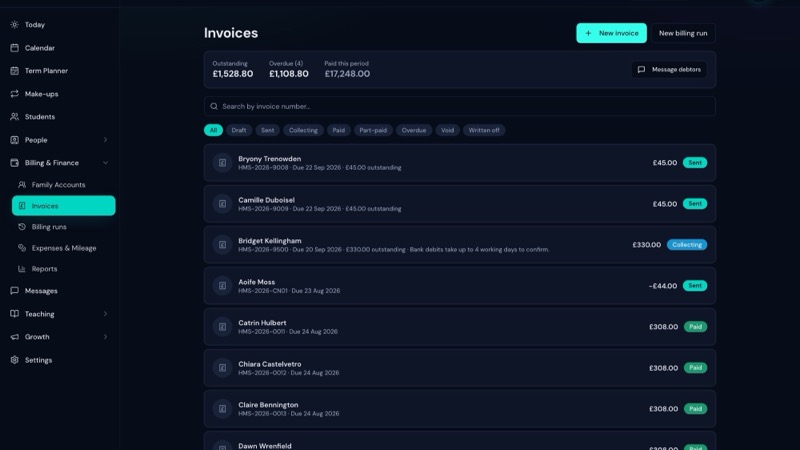
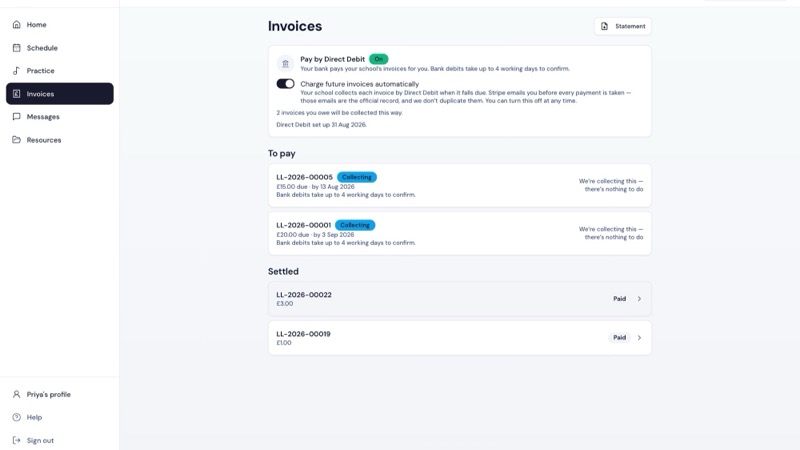
- Invoice everything, from one system. If every lesson is billed through one platform, your income figure is a report, not a reconstruction from bank statements, three apps and memory. (This is where running your studio on software pays a tax dividend: in LessonLoop, every invoice and payment is already itemised and exportable — your income side of MTD is just there.)
- Capture expenses when they happen. Photograph receipts into a folder (or your accounting app) the day they occur. Keep records at least five years after the filing deadline — HMRC can ask.
- Move your tax aside monthly. A standing order of 25–30% of takings into a savings pot turns the January bill — and the July payment on account — into a non-event.
And the maths habit that sits above all of them: know your numbers before the year happens. Your rate should already carry your costs and your tax — if you set it by working backwards from target income (our free hourly rate calculator does exactly this), the end-of-year figures stop being a surprise, because you designed them.
When to get an accountant
Honest answer: most sole-trader teachers with tidy digital records can self-file comfortably. Bring in an accountant when any of these arrive — your first VAT-registration question (relevant once taxable turnover approaches the threshold — group classes and workshops count differently from some exempt private tuition, and the exemption rules are genuinely fiddly: music tuition taught personally by a sole trader is often exempt, but structures matter), employing or subcontracting other teachers, incorporating as a limited company, or simply crossing into MTD and wanting the quarterly rhythm set up properly once.
A few hundred pounds of professional fee (itself deductible) routinely pays for itself the first year.
A worked year, start to finish
Numbers make the system click. Meet a composite teacher: 20 teaching hours a week at £35, across 38 teaching weeks, with a typical cost base.
Income: 20 × £35 × 38 = £26,600, before the unfilled-slot haircut — call it £25,000 received.
Expenses, itemised the way HMRC likes: teaching room hire £1,900 · insurance and MU membership £210 · sheet music and materials £340 · instrument servicing £180 · software (booking, accounts, notation) £460 · mileage between two schools, 1,400 business miles × 45p = £630 · phone/internet business share £190 · safeguarding course and CPD £150. Total: £4,060.
Profit: £25,000 − £4,060 = £20,940 — the figure tax is computed on. Note the expense list cut the taxable figure by 16%: at basic rate plus Class 4 NI, those records are worth roughly £1,050 in tax not overpaid, against perhaps two hours of receipt-photographing across the year. That’s the highest hourly rate this teacher earns all year.
The first-year ambush, named: in January, our teacher owes the year’s bill plus a first payment on account of about half as much again, with another instalment in July. The 25–30%-aside habit exists precisely so this paragraph is boring when it happens to you.
Quick answers
Do I need to register if teaching is a side income? Above £1,000 gross in the tax year, yes. Below it, the trading allowance covers you — but keep records anyway; growth has a habit of arriving.
Exam fees parents repay me — income? Yes: count the reimbursement as income and the fee you paid as an expense. Net effect nil, records clean.
Can I claim my piano? An instrument used for teaching, yes — usually in full in-year via the Annual Investment Allowance, proportioned if there’s substantial personal use. Keep the receipt; document the proportion logic.
Cash in hand is simpler, surely? Until it isn’t. Undeclared income is evasion, and the practical risks (no records for a mortgage application, no MTD trail, an awkward HMRC letter) dwarf the saving. Invoice everything; the system above makes declared income nearly as effortless.
Written by Lauren, co-founder of LessonLoop and founder of LTP Music. LessonLoop keeps every lesson, invoice and payment itemised and exportable — the income records MTD wants, produced as a side effect of running your diary.