HMRC requires self-employed records to be kept for at least 5 years after the 31 January submission deadline of the relevant tax year: a 2022/23 return filed by 31 January 2024 means keeping records until January 2029. From 2024/25 cash basis is the default. Making Tax Digital adds digital records and quarterly updates from 6 April 2026 above £50,000.
Practical guidance, not personalised tax advice. Every figure below was checked against HMRC’s own guidance on gov.uk on 4 September 2026; thresholds and rules move, so check gov.uk or an accountant for your own numbers.
The rule, in one line
“You must keep your records for at least 5 years after the 31 January submission deadline of the relevant tax year.”
HMRC’s worked example: a 2022 to 2023 return filed by 31 January 2024 means keeping those records until at least January 2029. There is a longer tail for very late filers — if a return goes in more than 4 years after the deadline, the period becomes 15 months after you sent it.
Five years past the deadline means a music studio is holding roughly six years of paperwork at any moment. That is the practical planning number.
What a music studio actually has to keep
HMRC requires records of your business income and expenses for Self Assessment, and records of your personal income. Translated into a teaching studio:
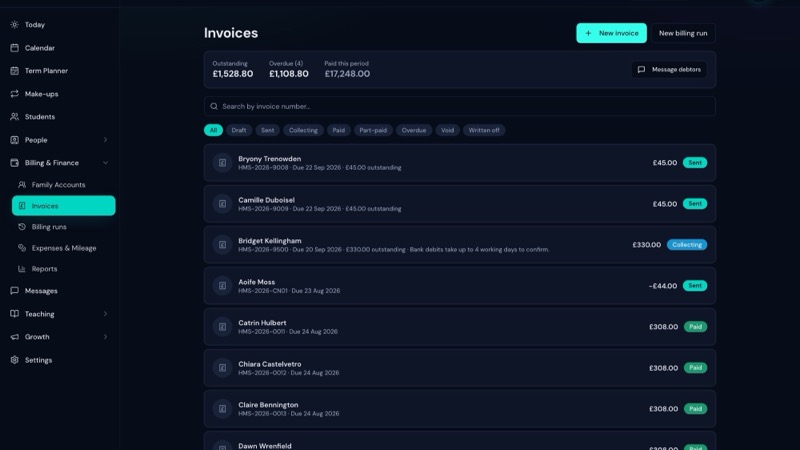
Income. Every invoice you issued and what was paid against it, including part payments, credits and write-offs. Bank statements for the account fees land in. If you take card payments, the payout records that reconcile the gross to the net.
Expenses. A receipt or invoice for anything you claim: instruments and repairs, sheet music and software, room hire, insurance, MU or ISM membership, accountancy, CPD, the business share of phone and internet.
Mileage. A log with date, from, to, miles and purpose for every business journey. HMRC’s approved rates are 45p a mile for the first 10,000 business miles and 25p after that, or actual costs proportioned to business use — one method per vehicle, kept consistent. The log is the difference between claiming this and forfeiting it.
The evidence underneath the income. Your lesson records — who was taught, when, and what was charged — are what make an income figure defensible if anyone asks. A studio that can produce a register alongside an invoice has a much shorter conversation than one that cannot.
Cash basis is now the default
HMRC’s guidance sets out two ways to record income and expenses:
- Cash basis — you record income or expenses only when you receive money or pay a bill.
- Traditional accounting — you record by the date you invoiced or were billed, whatever the money did.
From the 2024 to 2025 tax year cash basis is the default for sole traders, though you can opt for traditional accounting instead. For most teaching studios cash basis matches reality: a termly invoice issued in August and paid in September is September’s income, which is also when it hit the account.
The consequence worth knowing: on cash basis your year-end figure is what actually landed, so an unpaid December invoice is not income until it is paid — and chasing it in March moves it into a different tax year.
What Making Tax Digital changes
Making Tax Digital for Income Tax replaces one annual return with digital records plus quarterly updates, phased by qualifying income (self-employment and property, gross, before expenses):
| From | Qualifying income above | Based on the tax year |
|---|---|---|
| 6 April 2026 | £50,000 | 2024 to 2025 |
| 6 April 2027 | £30,000 | 2025 to 2026 |
| 6 April 2028 | £20,000 | 2026 to 2027 |
Quarterly update deadlines, on the standard 6 April alignment, are 7 August, 7 November, 7 February and 7 May. Each update carries totals for each income and expense category, cumulative from the start of the tax year — not just that quarter — and one has to be sent even for a period with no income or expenses. HMRC does not receive individual records; it receives the totals.
There are exemptions, including for people who are digitally excluded, and the full detail is in our guide to Making Tax Digital for music teachers.
The habit that makes January boring
Almost every painful January traces to the same thing: income that has to be reassembled at year end from four places that never agreed with each other.
Three habits fix it, and they cost nothing:
- One place for income. Every lesson, every invoice, every payment, in a system that reconciles them to each other rather than in a spreadsheet that records the invoices and a bank statement that records the money.
- A separate business account. Not a legal requirement for a sole trader, but it is the single biggest reduction in year-end work.
- Log mileage as you drive it. Nobody has ever successfully reconstructed a year of journeys in January.
What LessonLoop keeps for you
Every record above already exists in the software, because it is the same data that runs the teaching:
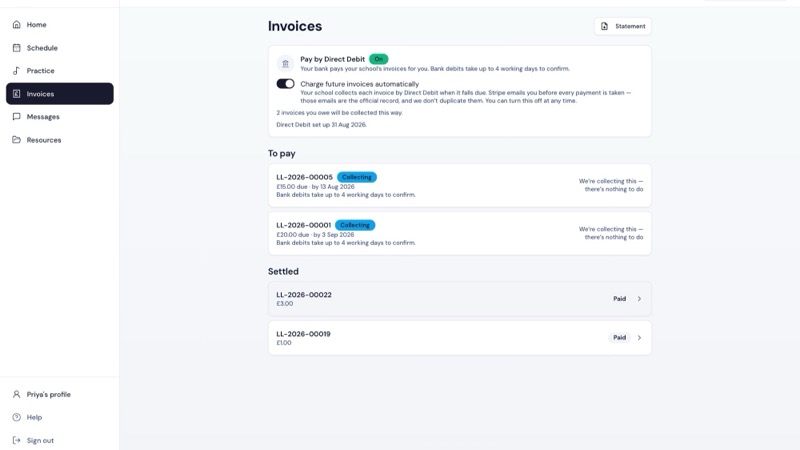
- Invoices, payments, credits, refunds and write-offs, each traceable to the lessons that produced them.
- Expenses and mileage kept against the UK tax year, with mileage recorded per journey and reported alongside revenue.
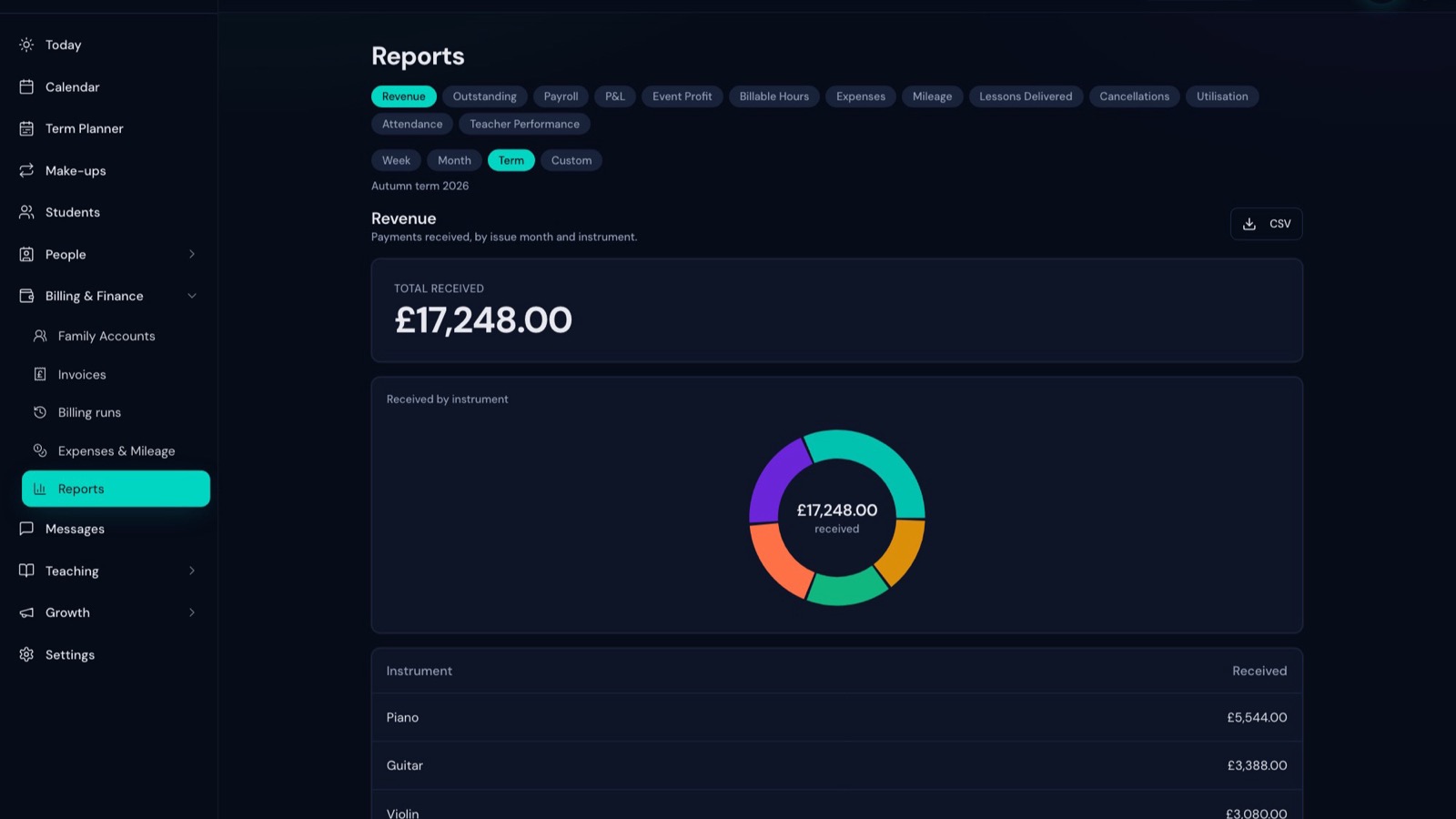
- Thirteen reports — revenue, outstanding, payroll, P&L, expenses, mileage and more — by week, month, term or a custom range, with CSV out.
- A one-way sync of invoices and payments into Xero, so your accountant reads clean data without you exporting anything.
- An audit log behind consequential changes, so “who wrote that invoice off” has an answer.
- A full export, any time, under UK GDPR, with no lock-in — which matters more for records you have to hold for six years than for anything else in a buying decision.
Music teacher software is £15 a month with unlimited pupils; music school software is £39 with unlimited teacher accounts.
Sources
- HMRC, keeping your pay and tax records and how long to keep your records — checked 4 September 2026
- HMRC, check if you’re eligible for Making Tax Digital for Income Tax and the quarterly-update guidance — checked 4 September 2026
Related reading
- Self Assessment for music teachers — expenses, deadlines and what to set aside
- Making Tax Digital for music teachers — the thresholds, the dates and what changes
- Music lesson pricing models — when the money arrives decides how the year reconciles