There are five UK music lesson pricing models: pay-as-you-go, termly in advance, monthly rolling, lesson packs, and hybrids. They differ in when the money arrives, what a missed lesson costs, and how much admin each takes. Termly in advance is the most common for UK schools; monthly rolling — the annual fee divided by twelve — is easiest for families to budget.
Most studios do not choose a pricing model. They inherit one, usually from whoever taught them, and then spend years patching the parts of it that do not fit. This is what each model actually does once a term is short, a child is ill, or you want to raise your rate.
The five models
1. Pay as you go
The parent pays for each lesson, at or near the lesson.
Cash flow: worst of the five. You are always being paid in arrears for work already done, and your income drops the week a family goes on holiday. When a lesson is missed: nothing to argue about — nobody paid — which is exactly the problem. Your slot was reserved, you turned other enquiries away from it, and you earn nothing. Admin: highest per pound collected. One transaction per lesson per pupil. Use it for: adult learners, taster lessons, and anyone genuinely irregular. Not for a school.
2. Termly in advance
One invoice per term, per pupil, issued before the term starts.
Cash flow: best. The term is funded before it is delivered, and you know in week one what the term is worth. When a lesson is missed: your policy decides, and because the money is already with you the conversation is about a credit rather than a refund — which is a much easier conversation. Admin: lowest, if the invoices generate themselves. Three billing runs a year instead of a hundred and twenty transactions. The catch: a termly bill is a big number arriving three times a year, and January is the worst of the three. Payment plans fix that without going to monthly.
3. Monthly rolling
The annual fee divided by twelve, collected on the same day every month, including the holidays.
Cash flow: smooth, and it survives August — the month that catches out every teacher on termly billing. When a lesson is missed: the same policy applies; the payment does not change. Admin: low if it runs on Direct Debit, high if it runs on standing orders you have to reconcile by hand. The catch: you have to explain it once, properly. “You are paying for 36 lessons across 12 months, not for the lessons in this particular month” is the sentence. Families who understand it prefer it; families who do not will query every August.
4. Lesson packs and blocks
Ten lessons, bought up front, used within a window.
Cash flow: good, and it front-loads. When a lesson is missed: the pack absorbs it, which parents like and which quietly makes your diary unplannable — a pupil with three lessons left in June has no fixed slot in September. Admin: medium, and it grows. Every pack has its own balance and its own expiry. Use it for: adults, short courses and exam-preparation intensives. It is a poor fit for a school timetable that has to be the same every week.
5. Hybrids
Most real studios end up here: termly for children, monthly rolling for families who ask, packs for adults. That is fine, as long as each one is a published rule rather than a private arrangement — three models are manageable, thirty private arrangements are not.
How to work out a termly fee
Your lesson rate multiplied by the number of lessons that pupil will actually get.
That last part is where most termly fees go wrong. A UK state school year is 195 days — roughly 39 weeks — and most private studios teach 36 to 38 of them. But the lessons are not spread evenly across the weekdays: almost every English bank holiday is a Monday, so a Monday pupil can get two to three fewer lessons a year than a Wednesday pupil. Charge every weekday the same flat termly fee and your Monday families are subsidising everybody else until one of them counts.
Two workable answers: price per weekday from an actual count, or price everyone on the annual total divided by three (or twelve) so the weekday difference disappears into the average. Either is defensible. Pretending the difference does not exist is not.
The free term date planner counts teaching weeks, lessons per weekday and bank-holiday clashes from your own dates, and suggests billing dates. No email required.
The five decisions that come with the model
- When do invoices go out? Before the term, always. Invoicing behind the teaching means funding your own school.
- What happens to a missed lesson? Your cancellation and make-up policy decides it once, in writing, for everybody.
- Do you take a deposit or a joining fee? A deposit held against the final term removes most of your bad-debt risk. Say so at enrolment or not at all.
- When does the rate rise? Once a year, on a fixed date, announced a term ahead, applied to everyone. An expected increase costs nothing; a surprise one costs pupils.
- What are the discounts, in writing? Sibling rates and multi-lesson rates are marketing costs you can measure. Ad-hoc reductions for whoever asks are a subsidy paid by the families who never ask.
What this looks like when the software does it
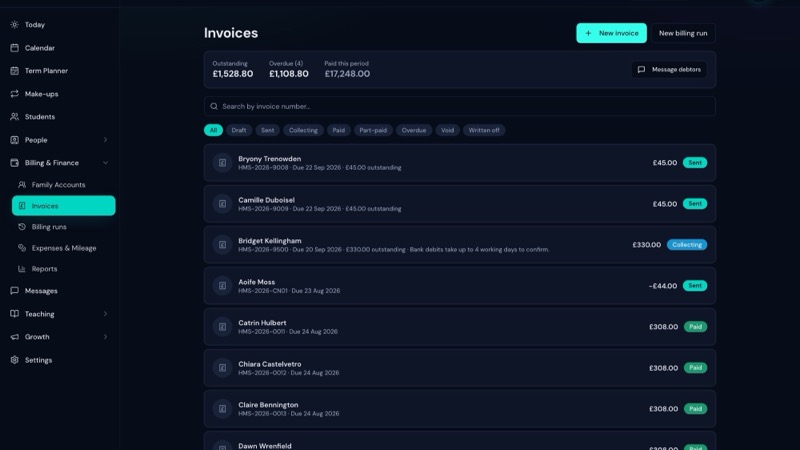
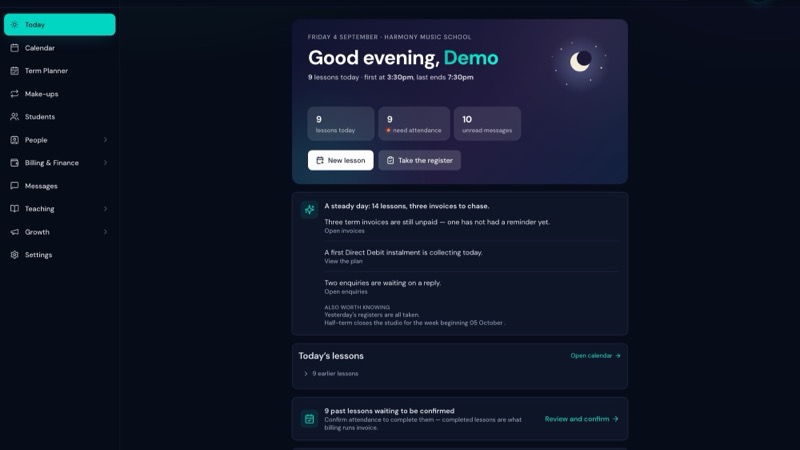
LessonLoop generates fees from the lessons already on the timetable rather than from a list somebody retyped, so the model you choose is a setting rather than a spreadsheet.
- Rate cards per instrument, subject, lesson length or teacher.
- Billing runs that are termly, half-termly or per lesson, with a preview of what a run will produce before it produces it.
- Payment plans that split a term into instalments, collected one by one as each date arrives — the fix for the January invoice.
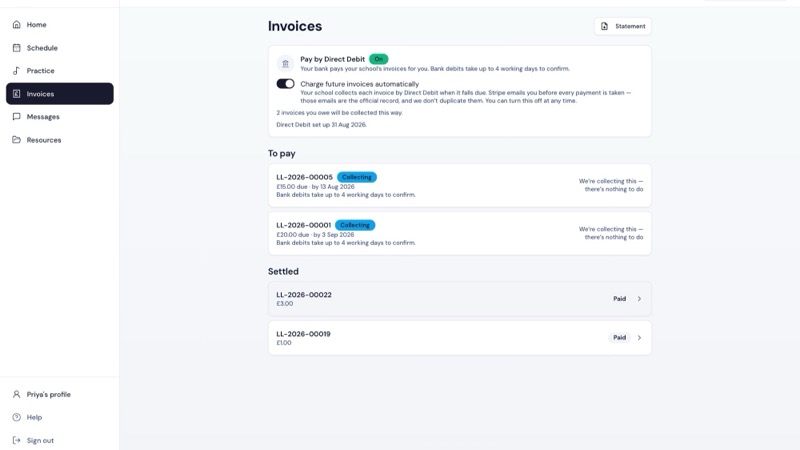
- Bacs Direct Debit and card payments into your own Stripe account, with the family setting the mandate up themselves.
- Automatic late fees by your own rule, and a reminder ladder that leaves a Direct Debit family alone while a collection is in flight.
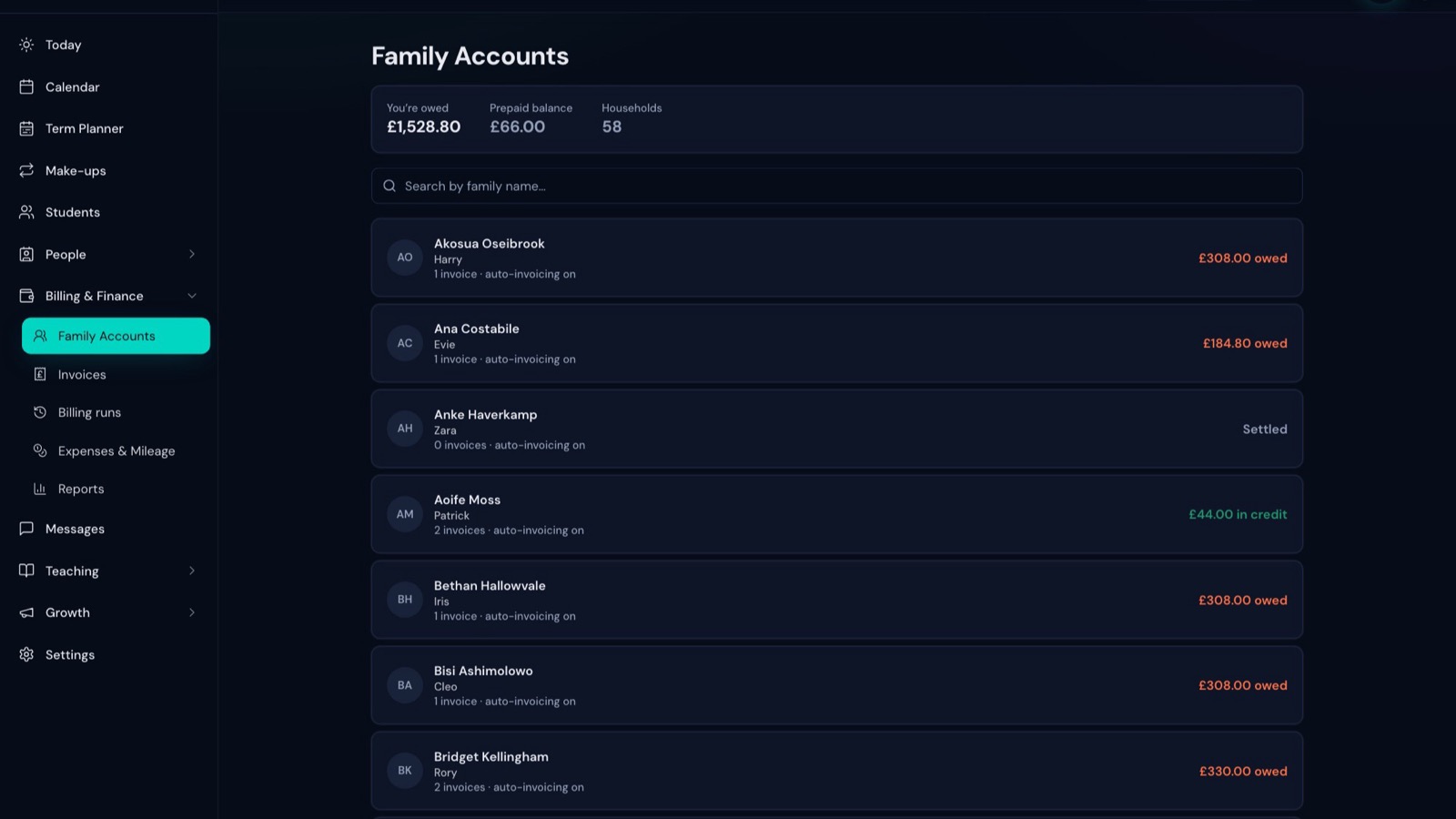
- Family accounts so three children on three different models still make one balance and one statement.
£39 a month, flat, with unlimited teacher accounts and pupils — see music school software, or what per-teacher pricing costs if you are comparing.
Related reading
- Music lesson prices UK 2026 — what to charge, by instrument
- How many teaching weeks are in a UK school year? — the number every termly fee depends on
- Music lesson cancellation policies — the document that stops the arguments
- Collecting fees by Direct Debit — Bacs, mandates and the four-working-day timing