You need no teaching qualification, degree or registration to teach music privately in the UK. What you do need before your first child pupil is an Enhanced DBS check — available in your own name since 21 January 2026 — and public liability insurance, which is £40–£90 a year standalone or comes with Musicians’ Union or ISM membership.
Here’s the sentence that surprises almost everyone who Googles this: you do not need a teaching qualification, a degree, or anyone’s permission to become a private music teacher in the UK. No PGCE, no QTS, no registration body. If someone will pay you to teach them the piano, you are a piano teacher.
That’s the good news and the trap. Because while the legal barrier is zero, the difference between “I teach a few pupils” and “I run a teaching practice that pays my rent” is a short list of professional moves — and the teachers who make them in their first months build something durable, while the rest drift. This is the list.
(The classroom route — salaried school posts — runs through a degree and QTS, and gov.uk’s Get Into Teaching covers it well. This guide is the other route: self-employed, private, your own studio. We’ve compared what each route pays in how much music teachers earn.)
Step 1: the credibility stack (what replaces the PGCE)
No qualification is required — but parents are buying trust, and trust has proxies. In rough order of weight:
Your playing and your grades. Grade 8 on your instrument is the informal industry floor for teaching beginners-to-intermediate; a music degree or conservatoire background prices you higher from day one. If you’re under that line, teach the levels you’re clearly beyond, and keep your own learning visible.
Teaching diplomas — the upgrade path. The recognised route to formal teaching credentials without a PGCE: ABRSM, Trinity and LCM teaching diplomas (DipABRSM/ARSM-level upward). None are mandatory; each one moves your rate and your referrals. A goal for year two or three, not a prerequisite for starting.
An Enhanced DBS check. Since January 2026, self-employed teachers can finally get an Enhanced check in their own name (via a registered umbrella body — no employer needed) — do it before your first child pupil, and register it with the Update Service the day it arrives. Put “Enhanced DBS · Update Service” on your website; it answers the question every parent has and most won’t ask.
Public liability insurance. £40–£90 a year as a standalone purchase — or effectively included with membership of the Musicians’ Union or the ISM, both of which also bring contract templates, legal advice and the recommended-rates benchmark. For most new teachers, joining one of the two is the simplest way to acquire insurance, credibility and backup in a single move.
Safeguarding basics. A short online children’s-workforce course, lessons structured for visibility, all communication routed through parents. One afternoon; the full guide is DBS checks and safeguarding for music teachers.
That’s the whole stack: instrument credibility, DBS, insurance, safeguarding habits. A weekend of admin and you’re more professionally dressed than half the established teachers in your town.
Step 2: make it a business before it makes itself a mess
Register with HMRC once you’re past the £1,000 trading-allowance threshold (register by 5 October after the tax year you start). Open a separate bank account for teaching money on day one — not legally required, just the difference between January being arithmetic or archaeology. Set aside 25–30% of profit for tax as you go. The full picture — allowable expenses (instruments, music, room costs, mileage at 45p, software), Making Tax Digital’s 2026/27 rollout, payments on account — is in our Self Assessment guide for music teachers.
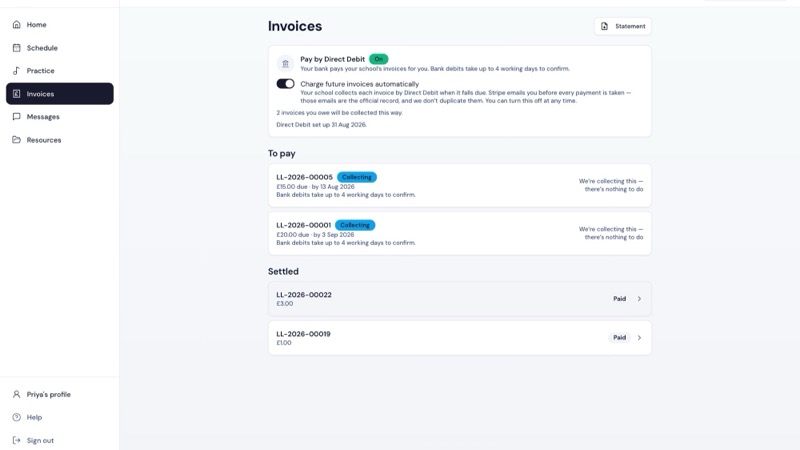
The habit that compounds most: invoice everything through one system from pupil number one. Cash-and-memory works at three pupils and silently breaks at twelve — and digital income records are exactly what MTD will require anyway.
Step 3: set a rate you won’t have to apologise for
New teachers consistently make the same pricing mistake: copying the cheapest local rate “until I’m established”, then discovering that raising prices on existing families is the hardest conversation in teaching.
Do it backwards instead. Decide the income you’re aiming for, count your real teaching weeks (UK term time is 36–39 — count yours properly), subtract realistic costs, allow for unfilled slots — and let the arithmetic set the rate. Our free hourly rate calculator runs the whole sum in thirty seconds, no email gate.
Sanity-check the answer against what lessons cost in your area — most of the UK sits at £30–£60/hour with London above — and remember the two structural rules: your 30-minute rate should be more than half your hourly rate, and the rate rises a little every September, with notice, forever.
While you’re deciding numbers, decide policy: notice periods, make-ups, no-shows. Write it down before your first awkward cancellation, not after. (Six questions, done for you: the make-up policy generator.)
Step 4: the first ten pupils
Every full studio started empty. The channels that actually work, ranked by effort-to-result for a new teacher:
1. The people who already know you. Tell everyone — the choir, the band, the school-gate parents, the church, your own old teachers. The first three pupils are nearly always one degree of separation away. Ask directly: “I’ve started taking pupils — do you know anyone?”
2. A Google Business Profile. Free, fifteen minutes, and it puts you on the map — literally — for “piano lessons near me”, which is how most parents actually search. Add photos, your DBS/insurance line, and gather a review from each early family. For a new local service business, this single listing outperforms almost everything else you could do online.
3. A simple booking page. One page: who you teach, where, your credibility stack, your rate (publish it — price-hidden teachers lose the parents worth having), and a way to book a first lesson without a phone call. A LessonLoop booking page does this out of the box, but any clear page beats none.
4. Local partnerships. Music shops (the counter staff get asked weekly for teacher recommendations), primary schools’ newsletters, community centres, churches with pianos. One A5 poster in the right music shop has filled more studios than most ad budgets.
5. Marketplaces — as scaffolding. Tutor platforms bring demand but take commission and own the relationship. Reasonable for filling early gaps; the goal is always to make your own name and booking page the front door.
The conversion trick most new teachers miss: offer a paid (not free) taster lesson at your normal rate, with a simple promise — if it’s not a fit, no hard feelings and a refund. Free tasters attract browsers; fairly-priced ones attract pupils, and the refund promise removes the same risk for parents at zero real cost to you.
The retention engine: parents stay when they can see progress and feel organised — reliable scheduling, clear invoices, practice that’s visible between lessons, a teacher whose admin never wobbles. Retention is where studios are actually built; a teacher who keeps pupils for four years needs a quarter of the marketing of one who keeps them for one.
Step 5: the boring systems that make it a career
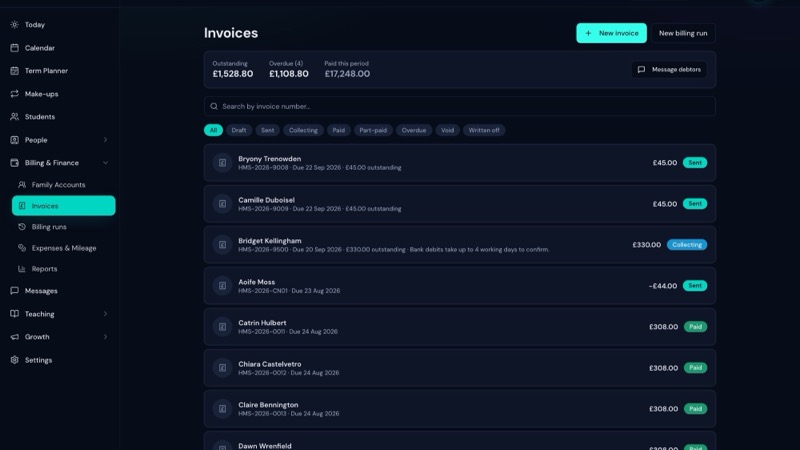
By pupil fifteen, the job quietly grows a second job: timetabling, invoicing, chasing payments, rescheduling, reminding, recording. Done by hand it eats your evenings — we measured what that costs in real money with the admin cost calculator, and for most teachers it’s thousands of pounds of unpaid hours a year.
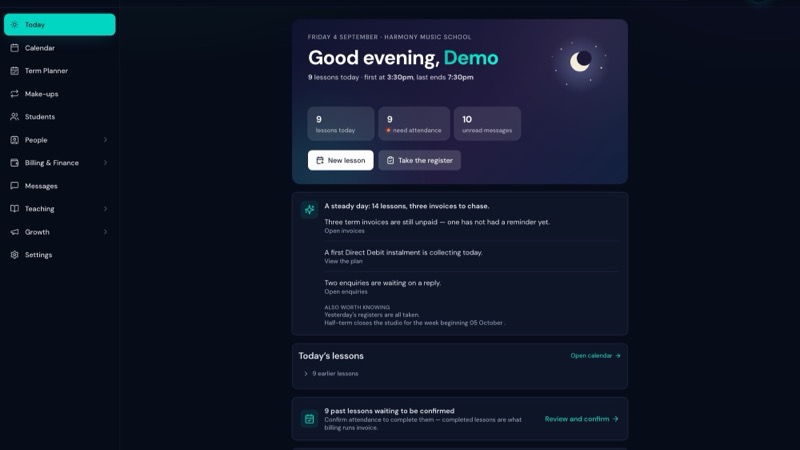
The fix is systems, adopted early, while they’re still cheap to adopt: one calendar that owns the truth, termly invoicing timed to the term dates, a written policy enforced consistently, records that accumulate by themselves. Whether that’s spreadsheets-plus-discipline or software built for music teaching, the principle is identical — the teaching is the job; the admin should be a side effect.
The whole route, in one box
Weekend one: DBS application + MU/ISM membership (insurance included) + safeguarding course. Weekend two: HMRC registration, separate bank account, rate set (calculator), policy written (generator). Weekend three: Google Business Profile, one-page booking site, the tell-everyone round. Then: teach brilliantly, invoice everything, raise the rate every September, and let retention compound.
No PGCE. No permission. Just the stack, the systems, and the playing you already have.
Quick answers
Can I teach while still studying for Grade 8 (or a degree)? Yes — teach the levels you’re securely beyond, price accordingly, and be straightforward about where you are. Plenty of excellent beginner teachers are intermediate players with strong communication; the credibility stack (DBS, insurance, policy, organisation) matters more to parents than the letters.
How long until a full diary? With the channels above worked properly — local, visible, asked-for referrals — most committed teachers reach 10–15 weekly pupils inside two terms. The cliff is rarely demand; it’s retention discipline and the September intake rhythm: families decide in late August and early January, so your visibility push should precede both.
Home studio, travel, or rent a room? Home wins on economics (no rent, no travel, claimable household proportion) if the space and household suit safeguarding-sensible teaching. Travelling to pupils charges a premium but donates your day to the road. A rented room suits city teachers without home space — price it into your rate from day one rather than absorbing it.
Do I need a website? You need a findable, bookable page — a Google Business Profile plus one clear page with rates and a booking route. A sprawling site adds little; an absent one quietly costs you every parent who Googled and found someone else.
Written by Lauren, co-founder of LessonLoop and founder of LTP Music — which started exactly this way: one teacher, one instrument, no PGCE, and is now 500+ pupils across a dozen schools. LessonLoop is the software half of that story.