UK classroom music teachers earn about £33,000 to £51,000+ on the England scales, plus London weighting. Peripatetic teachers are paid roughly the high £20s to the £40s per teaching hour, term time only, with travel and timetable gaps usually unpaid. Private studio income has no scale — it is rate × hours × teaching weeks × utilisation, minus costs.
“How much do music teachers earn?” has three honest answers, because there are three different jobs hiding inside the title. A salaried classroom teacher, a peripatetic visiting instrumental teacher and a private studio owner can all describe themselves as “a music teacher” — and their incomes are built on completely different machinery.
If you’re choosing between routes, combining them (most working music teachers do), or trying to work out why your diary is full but your income isn’t, the comparison below is the map.
Route 1: the classroom — salaried and structured
Music teachers employed in schools sit on the national teacher pay structure. On the 2025/26 scales, classroom teachers in England earn from roughly £33,000 (starting salary) to around £51,000+ at the top of the upper pay range, with London weighting adding several thousand more, and leadership responsibilities (head of music, head of performing arts) layering allowances on top. Scotland, Wales and Northern Ireland run their own scales in similar territory. Check the current year’s scales — they move with each pay award.
What the headline hides:
- The package is bigger than the number. Employer pension contributions under the Teachers’ Pension Scheme are worth a five-figure-feeling percentage on top, plus sick pay, parental leave and paid holidays — benefits a self-employed teacher must fund personally.
- The job is bigger than the teaching. Full timetables, marking, concerts, parents’ evenings and a curriculum that isn’t yours. It’s the most financially secure route and the least autonomous one.
Route 2: peripatetic — paid by the hour, between schools
Peripatetic (“peri”) teachers visit schools to teach instrumental lessons, engaged either by a music service/hub, directly by schools, or self-employed. Typical hourly rates in 2026 run from the high £20s to the £40s per teaching hour, varying by employer, region and qualification — with the Musicians’ Union publishing recommended rates that good employers benchmark against.
The two structural catches:
- Paid hours ≠ working hours. Travel between schools, gaps in the timetable, and admin are usually unpaid. A “£35/hour” peri day with four teaching hours across three sites can be a nine-hour working day — an effective rate barely half the headline.
- Term-time only. Thirty-six to thirty-nine paid weeks must fund fifty-two weeks of life. (This is the same maths private teachers face — we’ve written a full guide to counting your real teaching year.)
Done well — dense local timetables, several schools clustered tightly, hub work supplemented with private pupils — peri teaching is a solid living with school-holiday freedom. Done badly, it’s the most driving for the least money in music education.
Route 3: the private studio — the widest range by far
Private teaching has no pay scale, which means the honest figure is a formula, not a number:
Income = hourly rate × teaching hours per week × teaching weeks × utilisation − costs.
Plug in realistic UK values and the spread becomes obvious:
| Profile | Rate | Hours/wk | Weeks | Gross (before costs) |
|---|---|---|---|---|
| Side-line teacher | £25 | 8 | 38 | ~£7,600 |
| Part-time professional | £32 | 15 | 38 | ~£18,200 |
| Full-time soloist studio | £40 | 24 | 38 | ~£36,500 |
| Established studio, premium area | £50 | 28 | 39 | ~£54,600 |
Subtract real business costs (room, insurance, music, software, instrument upkeep — commonly £1,500–£3,000+) and remember tax and National Insurance come out of what’s left.
Three observations from those rows:
- Full-time private teaching at sensible rates clears classroom pay — without the pension, sick pay or holiday pay. Whether that trade is good depends on how much you value autonomy, and how disciplined your own pension contributions are.
- Hours have a ceiling; rates don’t. Twenty-eight contact hours of one-to-one teaching a week is close to the human limit — the diary maxes out. Past that point, every income gain comes from the rate, the format, or the team.
- The fifth variable is silent but huge: utilisation. Unfilled slots, churn between pupils and term-time holidays quietly take 10–15% off the theoretical maximum. A full-looking diary at 85% utilisation is a different income from the same diary at 95%.
If you want this formula computed on your own numbers — including costs and the unfilled-slot haircut — our free hourly rate calculator runs it backwards: tell it the income you want, it tells you the rate that delivers it.
The four levers that actually move private income
1. The rate — reviewed annually, not apologetically. The single highest-leverage change. A £3/hour rise across 22 weekly hours and 38 weeks is +£2,500 a year, for identical work. Small, predictable September increases (with a term’s notice) are absorbed without churn; five frozen years followed by a £10 jump are not. Benchmark against what lessons cost in your area, then price your experience honestly.
2. The format — groups and ensembles. Four beginners at £14 each in a 45-minute group out-earns one £40 hour — while costing each family less. Theory classes, ensembles and holiday workshops do the same arithmetic. Group teaching is a skill, and it’s the most under-used income lever in UK private teaching.
3. The calendar — holiday weeks. Intensive courses, exam bootcamps and summer workshops monetise the 13+ non-teaching weeks at day rates that often beat term-time hourly income. Two well-filled workshop weeks can add £2,000–£4,000 to a year.
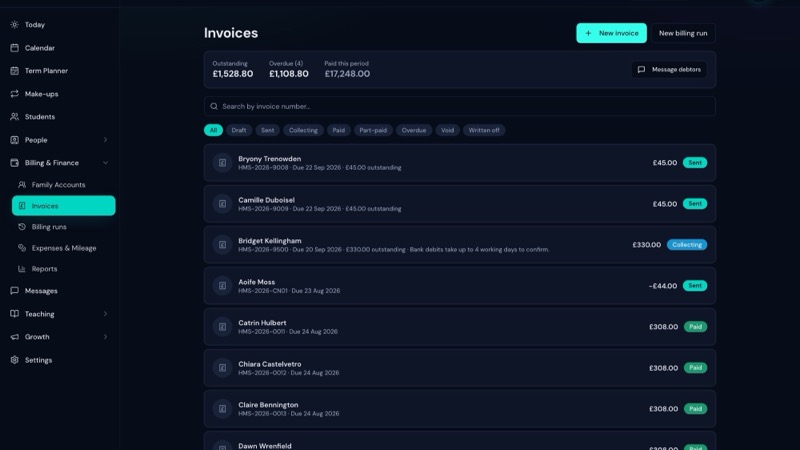
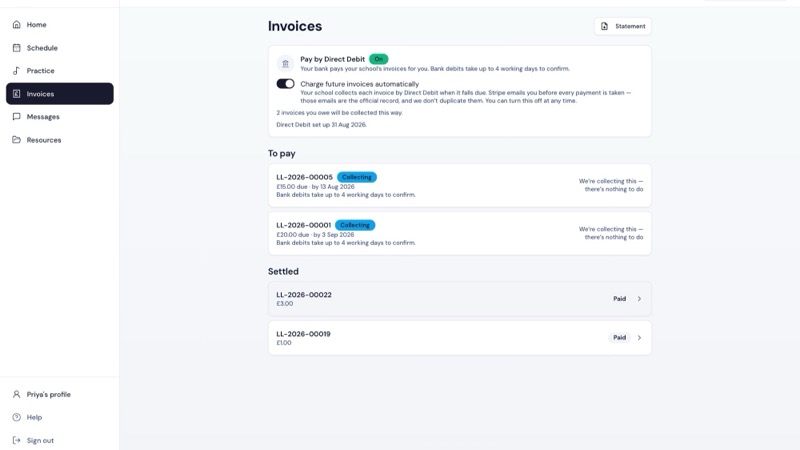
4. The team — from teacher to school. The ceiling-breaker. Bring in other teachers, take a margin on their lessons for providing the pupils, the room, the billing and the brand, and income detaches from your personal diary. This is how £40k teaching practices become £150k+ music schools. It also multiplies the admin — timetabling, payroll, invoicing and parent communication for a team is a genuinely different job, and it’s the point where running the school on proper software stops being a luxury. (We’ve also compared the per-teacher fees most platforms charge as you grow — flat pricing matters precisely here.)
The honest synthesis
- Security: classroom > peripatetic > private. Pension and sick pay are worth more than most self-employed teachers admit until they need them.
- Ceiling: private > peripatetic > classroom. No pay scale caps a studio owner with a waiting list and a team.
- Per-hour rate on actual hours worked: private teaching wins only if you control travel, fill your slots and charge properly — the three disciplines this article keeps circling back to.
Most resilient careers in UK music education are blends: a peri contract for the floor, a private studio for the ceiling, holiday courses for the gaps. Whatever the blend, the income follows the same rule everywhere: count the real weeks, charge the real rate, and keep the admin from eating the margin.
A worked path: £18k to £50k in four moves
Because the levers above can sound abstract, here’s the composite trajectory we’ve watched real teachers walk — each step one decision, none requiring new qualifications:
Year 1 — £18,000. Fifteen hours a week at £32, 38 weeks, solo, everything by hand. Evenings part-eaten by invoicing and reschedules; rate copied from a neighbour.
Year 2 — £26,000. Two changes: the rate moves to £36 after an honest backwards calculation (+£2,300), and the diary densifies to 19 hours by clustering two school runs and opening a Saturday morning (+£5,500). Nothing else changed — including, notably, the pupils, who absorbed the rise without comment.
Year 3 — £35,000. The format lever: two beginner groups (four pupils at £14 each, 45 minutes) replace two one-to-one hours, and a five-day summer intensive runs at £165 a head for ten children. Group hours now out-earn solo hours; holiday weeks stop being £0 weeks.
Year 4 — £50,000+. The team lever: a second teacher takes the overflow waiting list under the studio’s brand, with the studio billing families and paying the teacher — the margin on a full second diary is £8–12k, and the founder’s own teaching didn’t grow an hour. This is also the year admin-by-hand mathematically fails (two diaries, seventy families, three billing runs a term) — and the year systems stop being optional. It’s worth noting what the platform fee structure does at this point too: tools that charge per teacher quietly tax move four; flat-priced ones don’t.
None of those moves required luck. They required the count, the rate, the format, and the team — in that order, one a year.
Quick answers
Is private music teaching a “real” full-time living? At 22+ honest hours, sensible rates and 38 counted weeks — unambiguously yes, at or above classroom pay. The teachers for whom it isn’t are almost always under-charging, under-filled, or paying an unmeasured admin tax.
What about pension and sick pay? The honest asterisk on self-employment. Price them in: a private teacher matching a classroom package should be directing 8–10% of income to a pension unprompted. The hourly rate calculator lets you fold that into the target income line.
Do qualifications raise income? Diplomas (ABRSM/Trinity/LCM) move the rate you can credibly charge and open school/hub doors. They’re the highest-ROI formal credential in the private route — see the full route in.
Written by Lauren, co-founder of LessonLoop and founder of LTP Music — which grew from one piano stool to 500+ pupils and a team teaching across a dozen schools. LessonLoop is the software that runs it: scheduling, billing, payroll and a parent portal, on flat pricing that doesn’t tax the growth.