UK music education runs through four routes: classroom music, instrumental teaching arranged through 43 Music Hub partnerships covering every area of England, graded exams from ABRSM, Trinity, LCM and RSL, and private lessons at roughly £15–£32 per half hour. The national plan, published 25 June 2022, aims for every child in England to sing and play by 2030.
Parents ask “how do I get my child into music?” and get four different answers depending on who they ask, because there are four different systems and almost nobody explains how they connect. Teachers ask “where does my studio fit?” and get the same fog. This is the map.
Facts about the Music Hub programme and the national plan were checked against Arts Council England and gov.uk on 4 September 2026.
Route 1: classroom music in schools
Music is part of the national curriculum in maintained schools in England up to Key Stage 3, and available as a GCSE and an A-level after that. Academies set their own curriculum but most follow it closely. Scotland, Wales and Northern Ireland run their own curricula and qualifications.
What classroom music does well: reaches everybody, teaches listening, composing and context, and is free. What it does not do: get an individual child to Grade 5 on the violin. That is what the other three routes are for.
Route 2: Music Hubs
Arts Council England delivers the Music Hub programme on behalf of the Department for Education, funding a network of 43 Hub partnerships that cover every area of England.
A Hub is a partnership rather than a building — schools, local authority music services, orchestras, charities and independent providers working together in an area. Their stated aims are to support schools to deliver high-quality music education, to help all children engage with a range of musical opportunities in and out of school, and to help young people develop their musical interests further, including into employment.
Hubs hold two ring-fenced grants: a revenue grant for coordinating and supporting provision, and a capital grant for increasing the volume, range, relevance and accessibility of instruments, equipment and technology in the area.
In practice, for a family, a Hub is usually the route to:
- Whole-class instrumental teaching — a term or a year of a whole class learning together, often free to the family.
- Instrument loan, sometimes free, sometimes a small termly hire charge.
- Ensembles, bands, choirs and orchestras at area level.
- Subsidised individual or small-group lessons, often means-tested.
Find your local Hub through Arts Council England’s Hub finder. What each one offers, and what it charges, varies by area — that is the design, not a fault.
Route 3: graded exams
The main graded music exam boards operating in the UK are ABRSM, Trinity College London, the London College of Music and RSL Awards (Rockschool). Classical instruments most commonly run through ABRSM or Trinity; rock and pop most commonly through RSL. Grades run from initial or preparatory level to Grade 8, with performance and teaching diplomas above that.
Two things worth knowing before you enter a child for anything:
- Grades are optional. Plenty of excellent musicians never take one. They are useful as structure, as a shared vocabulary between teacher and parent, and — from Grade 6 upward — for UCAS points. They are not a measure of whether a child is musical.
- Each board sets its own syllabus, fees and entry windows, and the fees rise most years. Check the board’s own site for the current figure rather than a number in an article.
Route 4: private lessons
The largest part of UK music education by volume, and the least visible, because it is tens of thousands of self-employed teachers and small schools rather than an institution.
Typical 2026 rates with a qualified private teacher run £15–£32 for 30 minutes and £28–£65 for an hour, varying by instrument, region and experience, with London and the South East 20–40% above. The full breakdown by instrument has the bands.
There is no qualification requirement to teach music privately in the UK — no PGCE, no QTS, no registration body. What good teachers have instead is their own playing and grades, often a teaching diploma from ABRSM, Trinity or LCM, an Enhanced DBS check (which self-employed teachers have been able to obtain in their own name since 21 January 2026), and public liability insurance, usually through Musicians’ Union or ISM membership.
If you are a parent choosing one, those four are the questions to ask. If you are becoming one, the route in is here.
How the four routes actually connect
The honest version, from inside a music school:
- A child meets an instrument in whole-class teaching through a Hub, at school, aged seven or eight.
- The ones who take to it move to small-group or individual lessons — through the Hub if there is capacity and the family qualifies, privately if not.
- Graded exams arrive as structure once the lessons are regular, usually a year or two in.
- Ensembles — Hub-run, school-run or private — are what keeps most children playing through the teenage years, more reliably than grades do.
- The teenagers who continue do so because somebody scheduled it, invoiced it, chased it and made it feel normal. That is the unglamorous part, and it is most of the work.
What this means if you run the teaching
The system means a UK music school lives with several things at once: pupils arriving from a Hub’s whole-class programme, families paying different amounts for the same lesson, exam entries clustered into short windows, and a timetable spread across your own studio and other people’s schools.
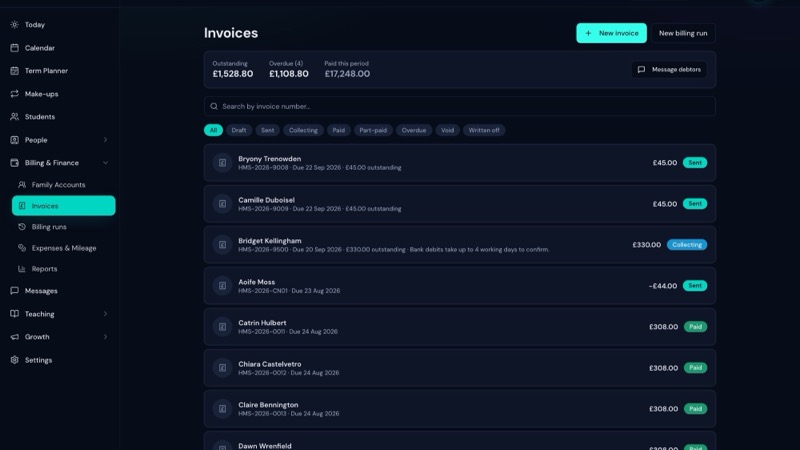
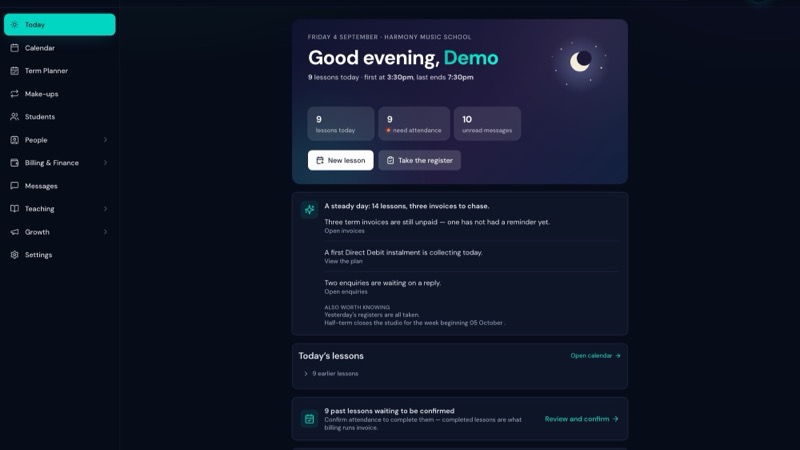
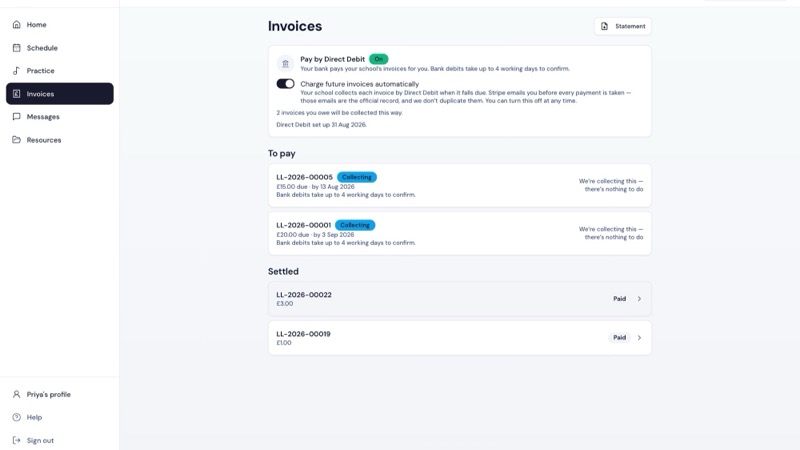
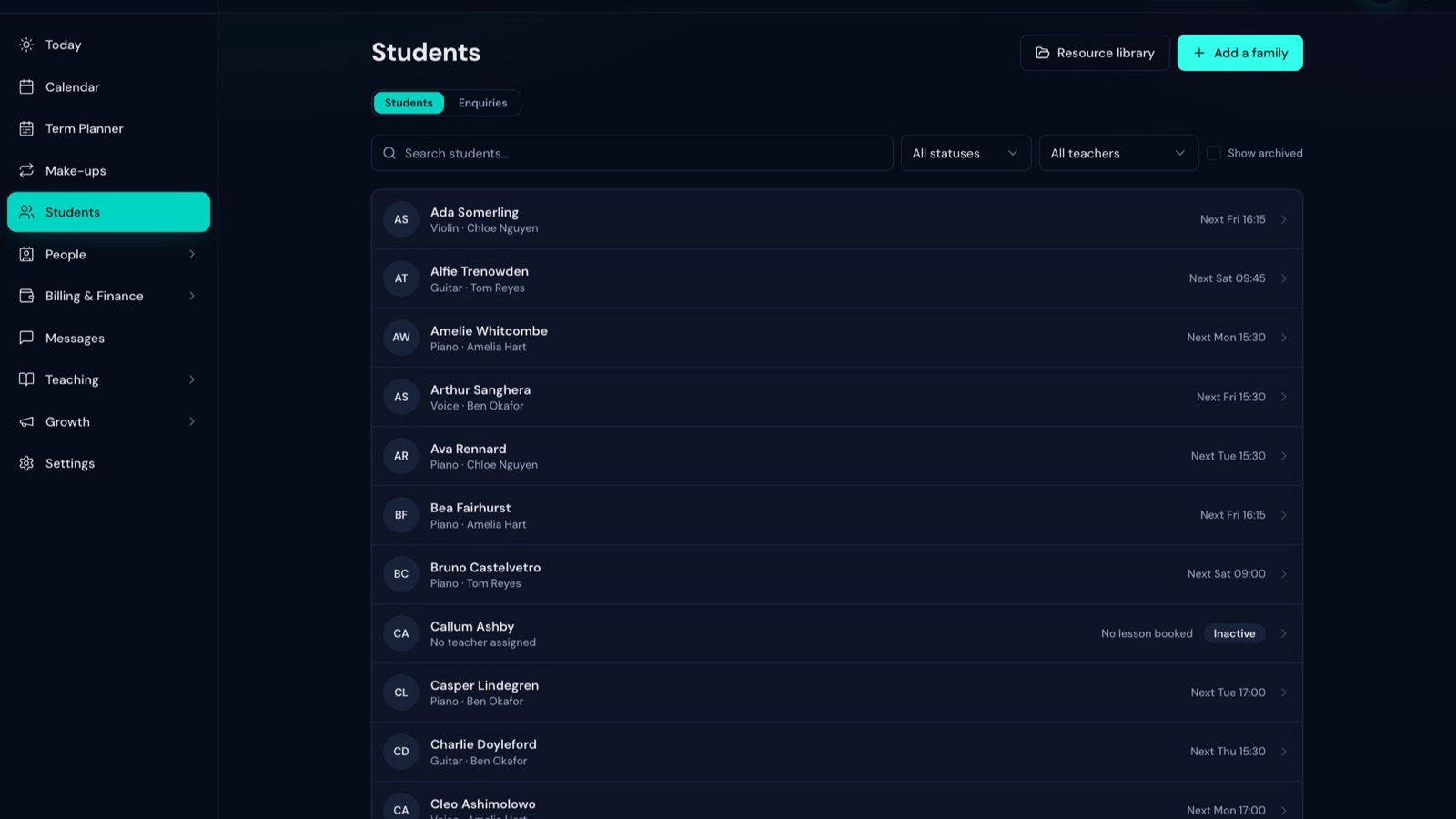
LessonLoop was built inside that: terms, half terms and closures set once and applied to every teacher; registers for lessons taught inside partner schools that have no fixed clock time; per-pupil billing inside a group; family accounts that reconcile across siblings; and a parent portal on your own domain. £15 a month Solo, £39 School with unlimited teacher accounts.
- Music school software — for a school with a team
- Music teacher software — for teaching on your own
- Music academy software — for more than one venue
Sources
- Arts Council England, Music Hubs — 43 Hub partnerships, the two ring-fenced grants and the programme aims; checked 4 September 2026
- Department for Education, The power of music to change lives: a national plan for music education, published 25 June 2022; checked 4 September 2026
Related reading
- Music lesson prices UK 2026 — what lessons cost, by instrument
- How much do music teachers earn? — classroom, peripatetic and private compared
- DBS checks for music teachers — which check, and the January 2026 change
- How many teaching weeks are in a UK school year? — 195 days, and what a studio actually teaches